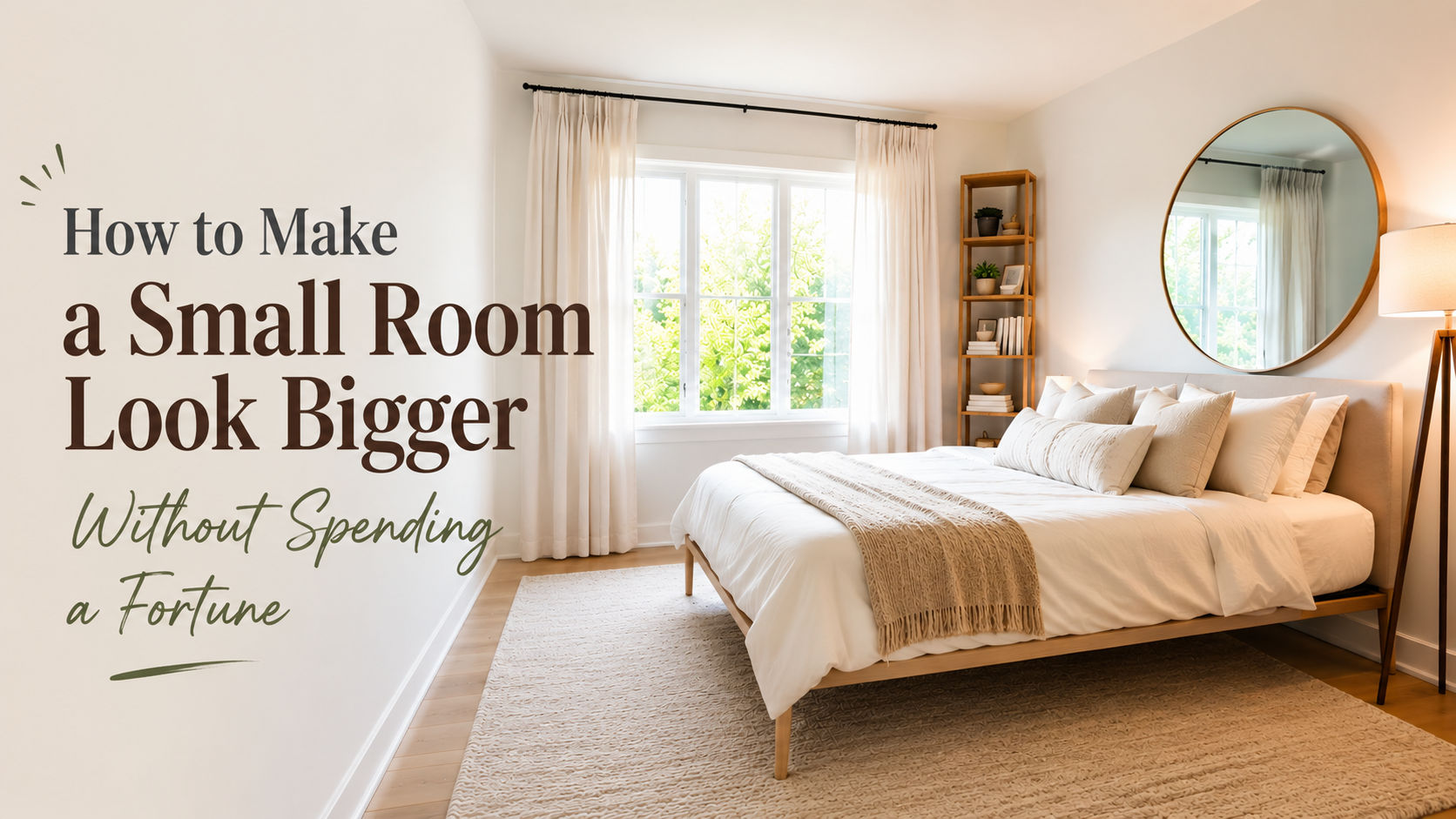
A small room doesn't have to feel small. Most of what makes a space feel cramped isn't its square footage it's how the light, color, and furniture inside it are working against each other. Fix that, and a 10x10 bedroom can feel twice its size without a single wall coming down.
None of the tips below require a renovation budget. Most just require rearranging what you already own; a few involve a purchase under $30. Here's what actually moves the needle.
1. Let the Floor Show
The single biggest space-eater in a small room is furniture that touches the ground on all sides dressers, low sofas, bulky bed frames. When you can see floor beneath your furniture, your brain reads the room as more open, even if the total floor area hasn't changed.
Try this: Swap solid-base furniture for pieces with visible legs. A bed frame or console table on slim legs instantly makes a room feel less packed.
2. Use One Light, Consistent Color Palette
Busy color transitions dark walls, a different-colored rug, mismatched furniture tones chop a room into visual "sections," which makes it feel smaller. A single light, consistent palette does the opposite: walls, furniture, and textiles blend together, so the eye sees one continuous space instead of several small ones.
This is also just good design fundamentals if you're not sure which direction fits your taste, our guide to 9 Home Decor Styles That Actually Make Sense breaks down which palettes and materials belong to which look, so you can pick one and stay consistent instead of mixing styles by accident.
3. Hang Curtains High and Wide
One of the most common small-room mistakes is hanging curtain rods directly above the window frame. Mount the rod a few inches higher than the window and a few inches wider on each side. The window visually "grows," the ceiling feels taller, and the wall reads as more open all from moving two brackets.
4. Add a Large Mirror, Not Several Small Ones
Mirrors bounce light and create the illusion of depth but one large mirror does this far more effectively than a cluster of small ones. Place it directly across from a window if possible, so it reflects natural light back into the room instead of a wall.
5. Scale Furniture to the Room, Not the Deal
A single well-proportioned piece almost always makes a small room feel bigger than several small, "space-saving" pieces crammed in together. Two nightstands and a low dresser can visually clutter a room more than one slightly larger, well-placed dresser would.
Rule of thumb: fewer, right-sized pieces beat more, small ones.
6. Keep Window Sills and Ledges Completely Clear
Small horizontal surfaces near light sources windowsills, low ledges are easy to forget, but clutter there blocks light and draws the eye downward, making ceilings feel lower. Keep these surfaces empty or down to one small item, max.
7. Use Vertical Storage Instead of Floor Storage
Every piece of furniture you can get off the floor and onto the wall gives the room back visual square footage. Floating shelves, wall-mounted hooks, and tall (not wide) bookcases all store just as much while taking up a fraction of the floor's visual space.
This matters just as much in small kitchens, where counter space is even more limited our 11 Cozy Kitchen Styling Ideas guide has more room-specific ways to free up surfaces without losing storage.
8. Layer Your Lighting
A single overhead light casts flat, harsh shadows that flatten a room and make corners feel darker and closer. Adding two or three smaller light sources a floor lamp, a table lamp, a warm-toned plug-in creates depth through light and shadow, which reads as more spacious than one flat, bright source.
9. Choose a Rug That's Actually Big Enough
An undersized rug is one of the most common small-room mistakes. A rug that only fits under a coffee table (with furniture legs sitting off it) visually shrinks the floor. At minimum, front furniture legs should sit on the rug this ties the layout together and makes the floor read as one connected area instead of a patchwork.
10. Edit Before You Add
Before buying anything, remove. Small rooms have a lower "clutter ceiling" than large ones the same amount of stuff that looks fine in a big living room will overwhelm a small bedroom. A round of honest decluttering, done before any new styling, is the single highest-impact, zero-cost step on this list.
Once the room is edited down, a few well-chosen budget finds go a lot further than they would in a cluttered space we rounded up several in 5 Essential Economy Home Decor Finds on Amazon to Achieve a Minimalist Look, all picked with small, budget-conscious spaces in mind.
Frequently Asked Questions
Does painting a small room white actually make it look bigger?
White helps, but it's not required. What matters more is consistency a single light, uniform color across walls (and ideally trim) reads as more spacious than white walls paired with dark furniture or a busy accent wall. Soft neutrals, light greys, and warm off-whites all work as well as pure white.
What's the cheapest way to make a small room feel bigger?
Decluttering and rehanging curtains higher are both free and are usually the two highest-impact changes you can make in a single afternoon. A large mirror is the best low-cost purchase if you're willing to spend a little.
Do small rooms need less furniture or just smaller furniture?
Less furniture, rather than just smaller furniture. One right-sized piece usually reads as calmer and more spacious than two or three small "space-saving" pieces crammed into the same footprint.
Can lighting alone make a room feel bigger?
Yes, to a significant degree. Layered, warm lighting (multiple smaller sources instead of one overhead light) reduces harsh shadows and makes corners feel less closed-in, even without changing anything else in the room.

.jpeg&w=3840&q=75)
.webp%3FupdatedAt%3D1784596921652&w=3840&q=75)